Give creative work a clearer path to approval.
An independent, hands-on example of how I would organise asset reviews, document feedback and make it easier for a creative team to see what happens next.
By Gyorkem Yozgyur · DTU MSc Industrial Engineering & Management · October 2026
Make every decision findable.
A good workflow answers four questions: what is waiting, why was a change requested, who should act next, and what changed since the last review?
A review queue that people can use
Each fictional asset has a unique ID, owner, revision, current stage, rule references and next action.
Decisions with reasons
Record the review outcome, a written rationale and a dated decision history, rather than just changing a colour in a tracker.
Guidance people can use
A short review playbook clarifies the example workflow, documentation fields and what should be escalated.
Live asset review tracker.
Search, filter and open records. Add a review decision to update status and append an audit entry. Changes are stored only in this browser. Export the current records as CSV.
| Asset ID / name | Category | Version | Team | Review status | Action |
|---|
No matching assets. Clear a filter or adjust your search.
12 entries displayed · Local, illustrative dataset
From a spreadsheet to a review board.
Same records, a different view. Each card shows ownership and the next step. Open a card to read its history or write a decision; the board updates straight away.
What I would flag in a handover
Practice the judgement, not just the tracking.
These cases interpret selected public LEGO Brand Rules in Fortnite for illustrative review exercises. They do not represent universal LEGO standards or internal GAME approvals.
Altered supplied element
A creator submits a LEGO Islands scene where an existing provided element has been stretched into a different shape. What should the reviewer recommend?
Reference: rule on modifying existing elements.
Third-party franchise asset
A LEGO Islands concept includes a recognisable third-party franchise logo mixed with LEGO content. The creator says they have the other brand's permission.
Reference: third-party IP limitations, subject to stated exceptions.
Unclear rating information
A fictional LEGO Islands submission for Europe is marked with a PEGI 12 classification, and the review record contains no supporting age-rating notes.
Reference: LEGO Islands Europe / UK age-rating maximum.
Creative feedback can be specific, too.
A separate, general-purpose usability example (not a LEGO brand-rule judgement): compare an intentionally low-contrast button with a clearer revision. The observation, requested change and next review are easy to record.
Not every finding is a rejection
A reviewer should identify the relevant rule, explain the observed evidence, propose a next action and preserve the prior decision. Uncertainty or missing evidence can be escalated rather than forcing a premature approval.
Finding: provided element geometry altered
Action: request an unmodified element and ask for v1.3
Trace: rule reference, decision note, reviewer, timestamp
No modification
Existing LEGO elements in the cited Fortnite context must not be reshaped, cropped or recoloured outside allowed presets.
Third-party IP
The cited rules restrict mixing LEGO assets with external IP, with specific allowances for owned assets and the stated programmes.
No set recreation
The cited rules prohibit recreation of existing LEGO sets and products using LEGO content in those islands.
Audience rating
The cited LEGO Islands guidance lists a PEGI 7 maximum for Europe and the UK.
Read the original Epic Games documentation ↗. Summaries are selective and the source should be consulted before any real decision.
Show the evidence. Explain the decision.
Three worked examples model the difference between an observed fact, an applicable published guideline and the action a reviewer could take. These fictional examples are not official sign-offs.

Busy starting area
The entry path is partly blocked by a large decorative object, competing with the primary goal marker. This is a fictional readability review, not a brand-rule breach.

Clearer route and hierarchy
Move the object out of the route, make the landmark visible, and check with game design whether the revised composition supports playtesting.
Example evidence matrix
Each entry connects a public reference, a fictional observation and a proposed review outcome.
| Reference and scope | Illustrative observation | Decision and next action | Evidence to request |
|---|---|---|---|
| Modification restriction Epic / LEGO Brand Rules in Fortnite Applies to cited LEGO Islands context | A supplied in-game element appears to have been stretched beyond its existing shape. | Changes requested. Replace with an unchanged allowed element, then submit a new revision. | Screenshot of the modified element, reference to supplied element and the new revision. |
| Third-party intellectual property Public platform rule and exceptions | Unrelated franchise branding is combined with LEGO Islands content; approval scope is unclear. | Escalate / request changes. Check documented exceptions and route any unresolved rights question appropriately. | Source of the graphic, rights explanation, proposed compliant alternative. |
| Audience rating Public LEGO Islands IARC rating table | A fictional Europe / UK submission states PEGI 12, while the cited platform maximum is PEGI 7. | Escalate. Hold approval, verify rating and seek an appropriate resolution. | Current age-classification record and content review notes. |
Record what is visible in the submitted revision, without guessing why it happened.
Link to the exact guideline or flag missing / ambiguous authority.
Assign an action, request evidence and preserve the decision for the next reviewer.
Readable navigation matters
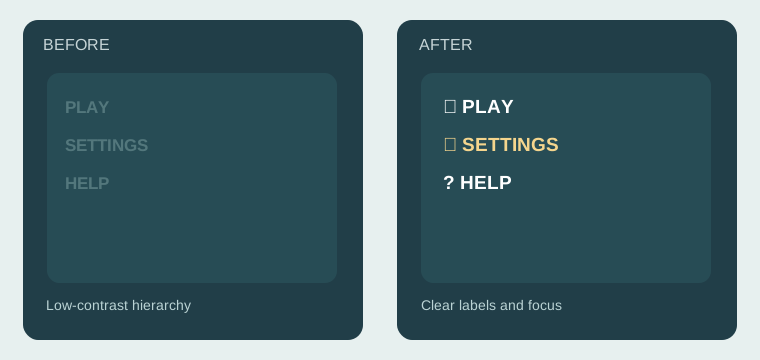
Separate recommendations about readability and player orientation from formal brand compliance findings.
GA-010 · proposed review note
Revision: v1.0. Observation: a provided element was altered in the fictional submission. Reference: public LEGO Islands modification rule. Outcome: changes requested. Next step: ask the creator to restore the permitted element and submit a revised file. Check on return: confirm the revised asset and preserve the earlier note.
This is a worked learning example, not evidence of previous professional asset approvals.
A lightweight review playbook.
This is a hypothetical workflow guide, not a reconstruction of any organisation's proprietary process. Designed to be readable by a new teammate and easy to adapt.
Register
Assign an ID, asset type, submitter, revision, reference and intended use. Attach accessible evidence.
Route
Check record completeness, identify applicable guidelines and send unclear cases to the right reviewer.
Assess
Compare the supplied creative material with relevant guidance and document specific observations.
Document
Record approved, changes requested or escalated, including rationale and a responsible next step.
Re-review
Receive a new revision, retain the decision trail, confirm outstanding actions and close only when ready.
- Unique asset ID and descriptive title
- Project or team and asset category
- Revision, submission date and accountable owner
- Applicable policy or guidance link
- Review decision, rationale and requested action
- Timestamped decision history and follow-up owner
- Guideline is ambiguous or two requirements conflict
- Third-party rights are uncertain or undocumented
- A change affects previously approved content
- An approval would exceed the reviewer's authority
- Critical evidence or the submitted revision is missing
- Deadline risk should be surfaced to the project lead
From physical configuration to creative assets.
Relevant experience is not the same as identical experience. This project demonstrates transferable process thinking without claiming that industrial engineering is a substitute for game design expertise.
Traceability and shared operating information
Designed and documented a cross-site configuration-control approach for serial-numbered products, including installations, changes and transfers. Developed a Python/SAP reporting pipeline feeding a shared Power BI interface.
Professional experience described in the applicant's CV. No internal screenshots, code or operational data have been used here.
Quality work near interactive gaming
Contributed to testing and updates for XPZONE interactive game experiences. Also supported technical quality documentation and coordinated KPI reporting across teams.
No claim of professional LEGO asset approval, Confluence administration or prior employment by the LEGO Group is made.